
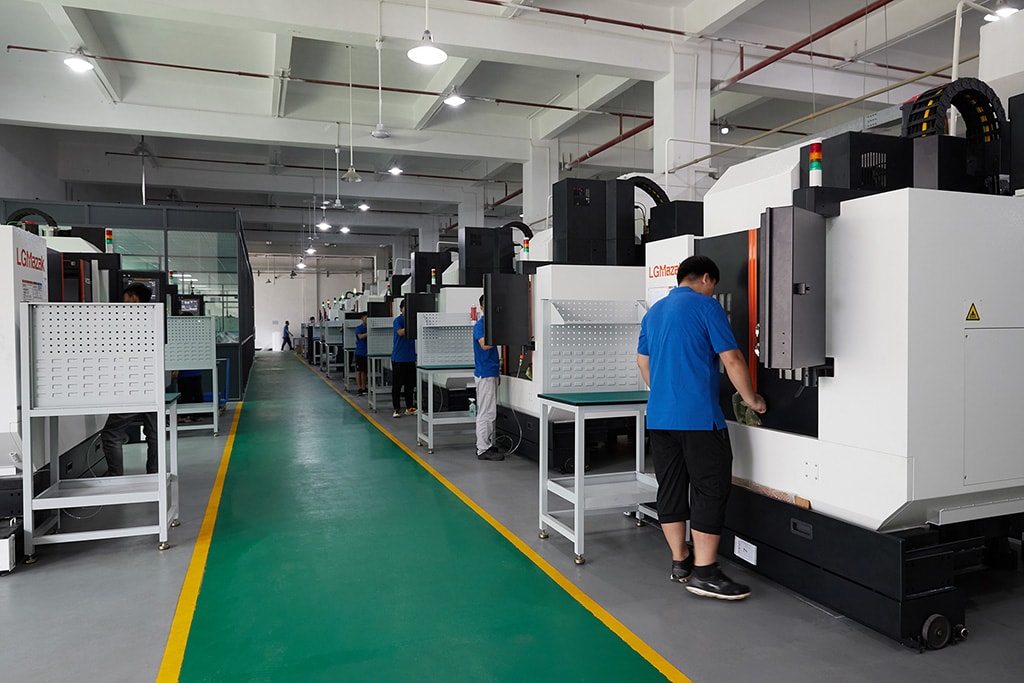
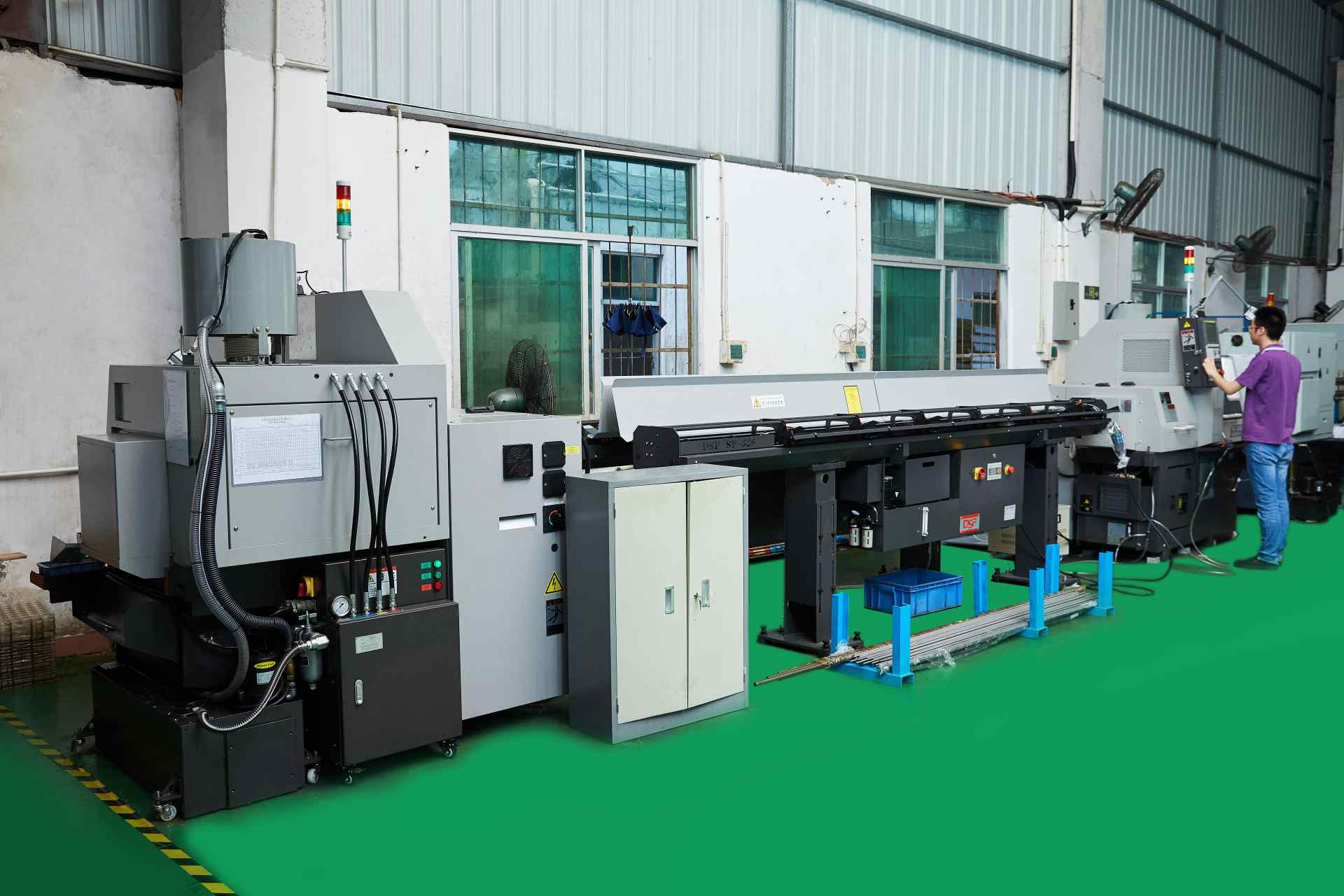
- 100+ production machines — 3-axis (50+), 4-axis (20+), 5-axis (20+), 25+ lathes, 7+ grinders in a 6,800 m² facility.
- ±0.003 mm milling and turning; ±0.002 mm grinding, verified on Hexagon CMMs.
- MOQ 1 piece, lead times of roughly 3 / 7 / 30 days depending on complexity and finishing.
- Material-matched finishing — anodizing, plating, and heat treatment chosen for the alloy, not bolted on as an afterthought.
1. What does this manufacturer machine, and how does it help your material choice?
A machined parts manufacturer is only as useful as the material range it runs daily, because the material is the first decision in the chain and the one that locks in the process and the finish. Our floor runs the metals buyers actually specify on drawings — aluminum, steel, stainless steel, brass, copper, titanium, and magnesium — plus engineering plastics for non-metal prototypes and insulators. That range matters because it means your material choice is not constrained by what a shop happens to stock; it is driven by what your part actually needs to do.
The practical value shows up in the selection conversation. When you send a drawing, we read it the way a buyer should: what load does it carry, what environment does it sit in, what does it touch. That reading — not a catalog list — is what produces a material recommendation, and it is the same reading that catches a mismatched alloy before it becomes a failed batch.
2. Which materials are available for custom machined parts?
The list below is what we machine, with the reason each family earns its place. Use it as a shortlist, not a spec — the grade still has to be written on the drawing.
| Material family | Grades we run | What it is for |
|---|---|---|
| Aluminum | 6061, 6063, 6082, 7075, 2014 | Lightweight structural parts, housings, brackets, heatsinks; anodizes well |
| Stainless steel | 303, 304, 316, 316L, 17-4PH | Corrosion resistance, hygiene, washdown; 303 for free-machining, 316L for aggressive environments |
| Carbon / alloy steel | 1018, 1045, 4140, 4340, 12L14 | Strength, wear, and heat-treatable surfaces; carburizing and nitriding available |
| Brass / copper | C360, H62, C110 | Electrical and thermal conductivity; brass machines easily, copper carries current |
| Titanium | TA2, TC4 (Grade 2 / 5) | Strength at low weight and corrosion resistance; stress relief above 500 °C outsourced |
| Plastics | ABS, POM, nylon, PTFE, PEEK | Non-metal prototypes, insulators, low-friction parts |
Every incoming lot is verified by XRF against its mill certificate before it reaches a machine. Mixed or mislabeled stock is caught at the door, which is the cheapest place to catch it. The alloy you specify is the alloy that gets cut.
3. How does material selection affect machinability and lead time?
Material choice is not free — it sets both the machining difficulty and the schedule. Aluminum machines fast and is cheap to hold on tolerance, so an aluminum part prototypes quickly. Stainless runs slower and can work-harden, so it costs more per part and takes longer. Copper is soft and gummy, which demands careful tooling to hold dimensions. Titanium is slow and hard on cutters, and its stress relief for some grades goes to a qualified outside partner, which pushes it into the longer lead-time tier.
The practical rule for a buyer: match the material to the requirement, and let the schedule follow the material. A simple aluminum bracket and a hardened stainless shaft are not the same order, and a manufacturer that quotes them the same lead time is guessing. We tie the lead time to the material and the number of process steps, which is why our tiers — roughly 3, 7, or 30 days — actually hold.
4. Which machining processes run in-house?
Keeping the process in-house keeps the material decision honest. When milling, turning, mill-turn, and grinding all run under one roof, a part does not bounce between subcontractors between operations, and the process for the material is already available rather than improvised.
| Process | Capacity | Max workpiece |
|---|---|---|
| 3-axis milling | 50+ centers | 1300 × 700 × 600 mm (milling) |
| 4-axis milling | 20+ centers | |
| 5-axis milling | 20+ centers | |
| CNC turning | 25+ lathes | Ø720 × 1280 mm |
| Mill-turn | Multi-task centers | Single-setup complex geometry |
| Grinding | 7+ (surface / centerless / cylindrical) | ±0.002 mm finishes |

5. Which surface finishes and heat treatments can be bundled?
The finish is where the material decision reaches the part's surface, and it has to match the alloy. We bundle finishing with machining so you receive a finished part, not a blank you still have to send somewhere else.
- Anodizing: standard and hard anodizing for aluminum — the default finish for housings and structural parts.
- Plating: zinc, nickel, silver, gold, and chrome — for steel corrosion protection and copper conductivity.
- Coating and polishing: powder coating, painting, brushing, and mirror polishing.
- Heat treatment: vacuum, bright, carburizing, nitriding, and stress-relief aging. In-house ovens reach 500 °C; titanium stress relief above that goes to a qualified partner.
6. What tolerances can this manufacturer hold?
A tolerance claim means nothing without the measurement to back it. Ours are tied to the process, and every critical dimension is checked on a CMM rather than assumed.
| Process | Held tolerance | Typical use |
|---|---|---|
| CNC milling | ±0.003 mm | Housings, brackets, prismatic parts |
| CNC turning | ±0.003 mm | Shafts, pins, bushings, round parts |
| Precision grinding | ±0.002 mm | Bearing seats, roundness-critical surfaces |
We hold these to process capability, not to a best-case claim. On a representative length characteristic (76.1–76.5 mm) our SPC shows Cpk = 1.851 against an initial-study target of Ppk ≥ 1.67. If a dimension on your drawing cannot be reliably held, we flag it during the review — before cutting, not after.
Read the tolerance band before you read the index. Cpk is a ratio of the tolerance band to the process spread, not an absolute measure of accuracy. The figure above was recorded on a length characteristic with a 0.4 mm band (76.1–76.5 mm) — wide by design. Hold the same process spread against a ±0.005 mm feature and it fails outright. Ask for the band, the subgroup count and the sampling window on every capability number a supplier quotes.
7. How is the material verified before machining?
The cheapest place to fail a machined part is the incoming stock. A mislabeled bar of stainless that is actually mild steel machines fine and fails in service, and no amount of inspection after the fact recovers it. That is why incoming material is checked with a handheld XRF spectrometer against the mill certificate, lot by lot, before it goes on a machine. The MES/ERP system then carries that lot through the entire run — raw material source, process parameters, machine data, operator, and inspection results — so a part can be traced back to its material in minutes, not days.
8. What does the material conversation look like when you request a quote?
Send a drawing and the quote comes back with more than a price. You get a material read — whether the alloy you picked fits the load, environment, and mating surface — plus a finish recommendation and, if there is a cheaper or more durable alternative, a note telling you so. If the drawing calls out a tolerance or a finish that will not hold or that conflicts with the material, you hear about it before you commit, not after the parts ship.
- Name the grade, not just the metal. "Aluminum" is not a spec; 6061-T6 is.
- Name the finish as a process. "Anodize clear, Type II" beats "make it shiny."
- State the environment. One sentence — indoor, outdoor, salt, washdown — confirms the material will survive it.
- Ask for the mill certificate. If a shop cannot produce one, the material provenance is a question mark.
9. What categories of machined parts does the floor run every day?
The materials on this page matter because they map to real part categories, not an abstract list. The same floor that machines an aluminum housing for an electronics enclosure also turns a hardened steel shaft and grinds a stainless bearing seat. The table below is the shortlist of what runs daily.
| Part category | Typical material | Typical process |
|---|---|---|
| Housings and enclosures | Aluminum 6061, 7075 | 5-axis milling, anodizing |
| Shafts and pins | Steel 1045, 4140; stainless 303 | Turning, then grinding |
| Brackets and structural links | Aluminum, steel | 3/4-axis milling |
| Threaded fittings and inserts | Brass C360, stainless 303 | Turning |
| Gears and wear parts | Steel, heat-treated | Milling or turning, then carburizing and grinding |
| Heatsinks and current carriers | Copper C110, aluminum | Milling, then plating where needed |
The point of the table is that a part category already points at a material and a process. When your drawing arrives, the reading starts from the same place — what the part does — and the material and process follow from there rather than being improvised.
10. How do you turn a part's function into a tolerance callout?
The fastest way to make a part expensive is to tolerance everything tightly when only two features control the function. A bearing seat needs a tight tolerance because the bearing has to fit; a cosmetic surface does not, and tolerancing it like a bearing seat buys nothing but cost.
The rule is to flag the critical dimensions — the ones a mating part or a load path depends on — and leave the rest at a general default such as ISO 2768-m. Milling and turning hold ±0.003 mm where it matters, and grinding holds ±0.002 mm where a surface has to be round and true. When a dimension cannot be reliably held, it gets flagged during review, before cutting, not after the parts ship. That one habit — tolerancing only what controls function — is the cheapest change a buyer can make to a drawing.
11. How do prototype and production quantities differ on the same part?
A single prototype and a thousand-piece batch run on the same machines and the same process chain, which is why MOQ 1 piece is useful rather than just cheap. The prototype validates the material, the finish, and the fit; the batch then repeats those settings at volume.
What changes with quantity is not the process but the economics and the inspection plan. A one-off is measured in full because there is no second chance; a production batch moves to sampling once the process is shown to be in control, with SPC charts tracking the key characteristics. Either way, the material verification at the door and the CMM check on the critical dimensions stay the same — those are not things you turn off when the quantity goes up. The process chain is the one constant across the quantity range.
Frequently Asked Questions
What materials do you machine for custom machined parts?
We machine aluminum, steel, stainless steel, brass, copper, titanium, and magnesium, plus engineering plastics including ABS, POM, nylon, PTFE, and PEEK. Incoming stock is XRF-checked against the mill certificate so the grade you specify is the grade you receive.
Do you provide material certificates for machined parts?
Yes. Incoming material is verified by XRF against the mill certificate, and material certificates, CMM inspection reports, and SPC charts ship with your parts. This gives you documented evidence of what the parts are made from and how they measure.
What tolerances can you hold?
±0.003 mm for milling and turning, and ±0.002 mm for precision grinding. Critical dimensions are verified on Hexagon CMMs, with process capability Ppk ≥ 1.67 at the initial study on key characteristics and Cpk ≥ 1.33 on general characteristics. Capability is reported per characteristic: every report names the feature, its tolerance band, the sample size, the sigma method, and the study window. And a measured example of Cpk 1.851 on a length feature.
What is your minimum order quantity?
Our MOQ is 1 piece. You can order a single prototype to validate material, finish, and fit before committing to a production run, which suits teams moving from a first sample into volume.
Can you bundle anodizing or plating with machining?
Yes. Standard and hard anodizing, zinc, nickel, silver, gold, and chrome plating, powder coating, painting, brushing, and mirror polishing can be bundled with machining, so you receive finished parts rather than raw machined blanks.
Can you machine titanium parts?
Yes, we machine titanium in grades such as TA2 and TC4. Titanium cuts slowly, and stress relief above 500 °C is outsourced to a qualified partner, so titanium parts usually fall into the longer lead-time tier.
What are your most common part categories?
Housings and enclosures, shafts and pins, brackets and structural links, threaded fittings, gears and wear parts, and heatsinks or current carriers. Each category already points at a natural material and process, which is how the selection conversation starts when a drawing arrives.
Can you handle both small and large production runs?
Yes. We machine from a single prototype up to production batches on the same process chain. The prototype validates the material, finish, and fit; the batch repeats those settings at volume, with sampling and SPC tracking the key characteristics once the process is in control.
Ready to have your parts machined with the right material and finish?
Send your drawing to [email protected] or call +86 13126536955 for a material, process, and finish recommendation plus a quote.