
Custom Machining Parts Services
Mill-turn centers combine a turning spindle with milling capability, so a part that has both turned and milled features — a shaft with a keyway, a housing with a turned bore and milled flanges — is completed in a single setup. That is more than a convenience. Every time a part moves between a lathe and a mill, it is re-fixtured, and every re-fixture is a chance to lose the datum and stack up error. Mill-turn removes those handoffs, which is why it is the default for complex parts where the turned and milled features have to stay concentric or aligned.
From your perspective, mill-turn also collapses lead time and removes the finger-pointing that happens when two separate operations disagree about whose setup caused a dimension to drift. One setup, one accountable process.
When does grinding become necessary, and which materials need it?
Grinding is the step you reach for when cutting cannot hold the tolerance. If a bearing seat has to be round and true to ±0.002 mm, or a surface has to be flat beyond what milling delivers, grinding takes over. Surface grinding flattens; centerless grinding handles long round parts efficiently; cylindrical grinding holds diameters and roundness on journals and bores.
Grinding matters most on hardened parts. Once steel has been carburized or nitrided, it is too hard to cut cleanly, so the final dimensions are ground after heat treatment. That sequence — machine, heat-treat, grind — is the standard path for wear parts, and it is why our floor keeps 7+ grinders next to the machining centers rather than treating grinding as an afterthought.
How do the services map to each material family?
The clearest way to read the service menu is by material, because each alloy family has a natural process and finish. The table below is the map we use when a drawing arrives.
| Material | Primary process | Follow-up | Typical finish |
|---|---|---|---|
| Aluminum | Milling / turning | Deburr, tap | Standard or hard anodizing |
| Steel | Turning / milling | Heat treat, grind | Zinc / nickel plating, powder coat |
| Stainless | Turning / milling | Polish | Brushed or mirror polish |
| Brass / copper | Turning / milling | Deburr | Silver / gold / nickel plating |
| Titanium | Milling / turning | Stress relief (partner) | Anodizing, polishing |
How are secondary operations bundled with machining?
Machining produces the geometry; secondary operations turn it into a finished part. Deburring, tapping, and laser marking are routine. Surface finishing — standard and hard anodizing, zinc, nickel, silver, gold, and chrome plating, powder coating, painting, brushing, and mirror polishing — is matched to the material. Heat treatment — vacuum, bright, carburizing, nitriding, and stress-relief aging — runs for steel and aluminum, with in-house ovens reaching 500 °C and titanium stress relief above that outsourced to a qualified partner.
Bundling these with machining matters for one reason: a finish is a process step with its own lead time. When finishing is scheduled as part of the job rather than discovered at the end, it runs in parallel and the quoted date holds.
What should you specify to get an accurate service quote?
The fastest way to a real quote is a complete package, because every gap in the spec is an assumption the shop has to price conservatively, or get wrong. Send the model as a STEP or IGES file, the toleranced 2D drawing, the material grade with any finish, the quantity in tiers, and the target date.
- Model + drawing, not a screenshot. The model defines shape; the drawing defines what is acceptable.
- Grade, not just metal. "Aluminum" is not a spec; 6061-T6 is.
- Finish as a process. "Anodize clear, Type II" beats "make it shiny."
- Quantity in tiers. Quote for 1, 50, and 500 so you can see where the unit price breaks.
- Target date. State it so the shop can flag early whether it is realistic.
How do you choose between milling, turning, and mill-turn for a part?
The process decision follows the part's shape, not its material. If the part is mostly flat, pocketed, or has features on several faces, milling is the natural start. If the part is round — a shaft, pin, or bushing — turning produces it far more efficiently. If the part has both turned and milled features that must stay aligned to each other, mill-turn is the answer because it keeps everything in one setup.
The practical test is the datum. Ask how many times the part has to be re-fixtured between operations. Every re-fixture is a chance to lose the reference and stack up error, so a part that would move three times between a lathe and a mill is a candidate for mill-turn. A part that never moves is a candidate for whichever single process matches its shape.
What tolerance can each process hold, and where does each one stop?
Each process has a tolerance it holds comfortably and a point where it hands off to a finer one. Milling and turning hold ±0.003 mm (milling) / ±0.002 mm (turning) on the features they own. When a surface has to be round and true beyond what cutting delivers — a bearing seat, for example — grinding takes over and holds ±0.002 mm.
| Process | Held tolerance | Where it stops |
|---|---|---|
| CNC milling | ±0.003 mm | Hands off to grinding for surfaces flatter than milling delivers |
| CNC turning | ±0.002 mm | Hands off to grinding for roundness-critical journals and bores |
| Mill-turn | ±0.003 mm (milling) / ±0.002 mm (turning) | Holds relationship between features in one setup; grinding still finishes critical seats |
| Grinding | ±0.002 mm | The finest step in-house; the floor after cutting |
The point of the handoff is that no single process owns the whole tolerance range. A drawing that asks milling to hold what only grinding can deliver is a drawing that will either cost more or get re-quoted, which is why the process decision and the tolerance decision belong in the same conversation.
How do the four processes chain together on a single part?
Real parts rarely use one process. A shaft may start on a lathe, get a keyway milled into it, then have its bearing journals ground after heat treatment. A housing may be milled on five axes, then have bores ground to finish. The value of running all four under one roof is that the chain stays intact — the part does not bounce between vendors, and the responsibility stays with one accountable party.
The sequence that matters most is machine, heat-treat, grind. Once steel is hardened, it is too hard to cut cleanly, so the final dimensions are ground after heat treatment. That ordering is standard practice, and it is why grinding sits next to the machining centers on our floor rather than being treated as an afterthought. When the process chain is planned as one job, the quoted date holds; when it is assembled step by step, each handoff adds days.
What this shop actually runs
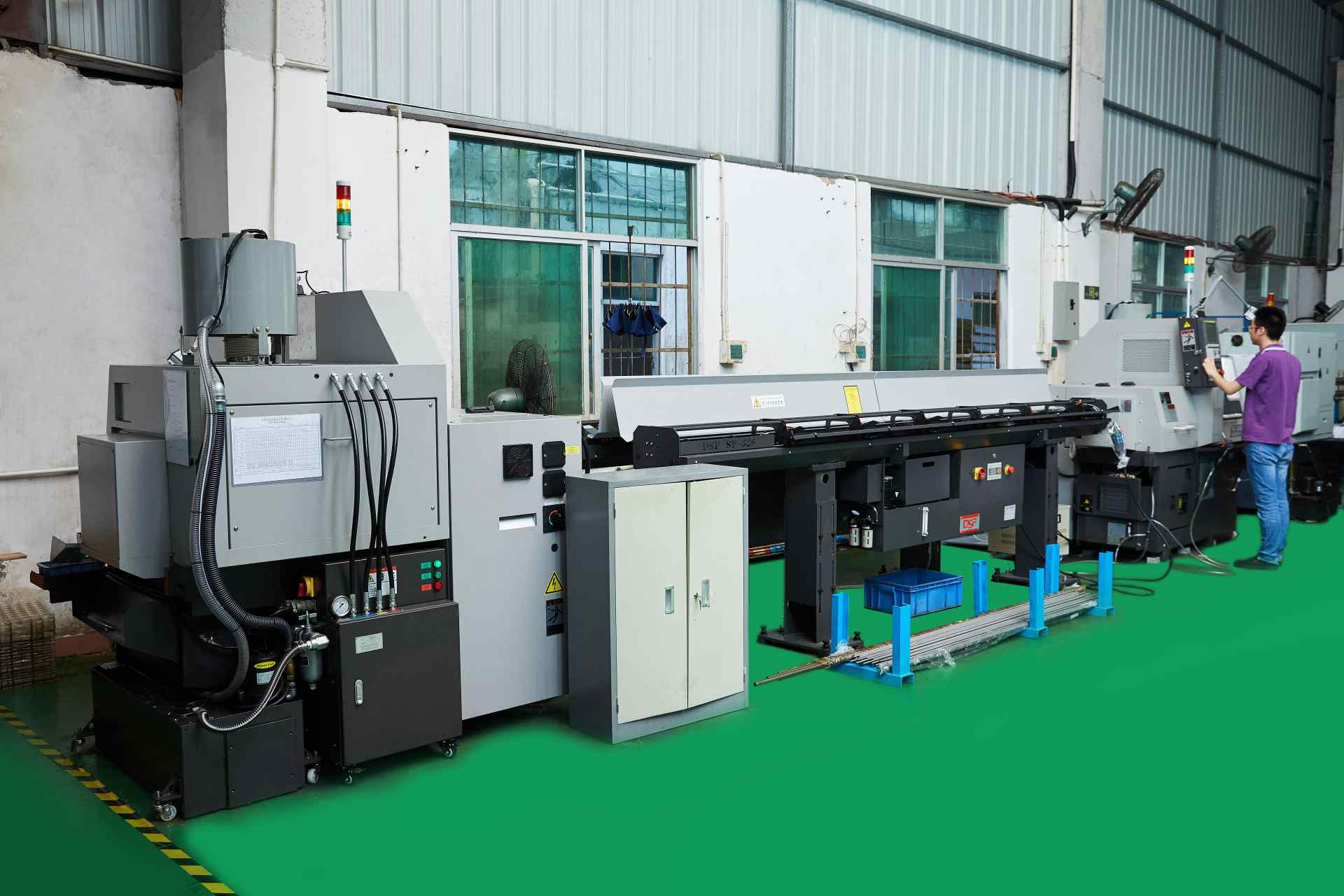
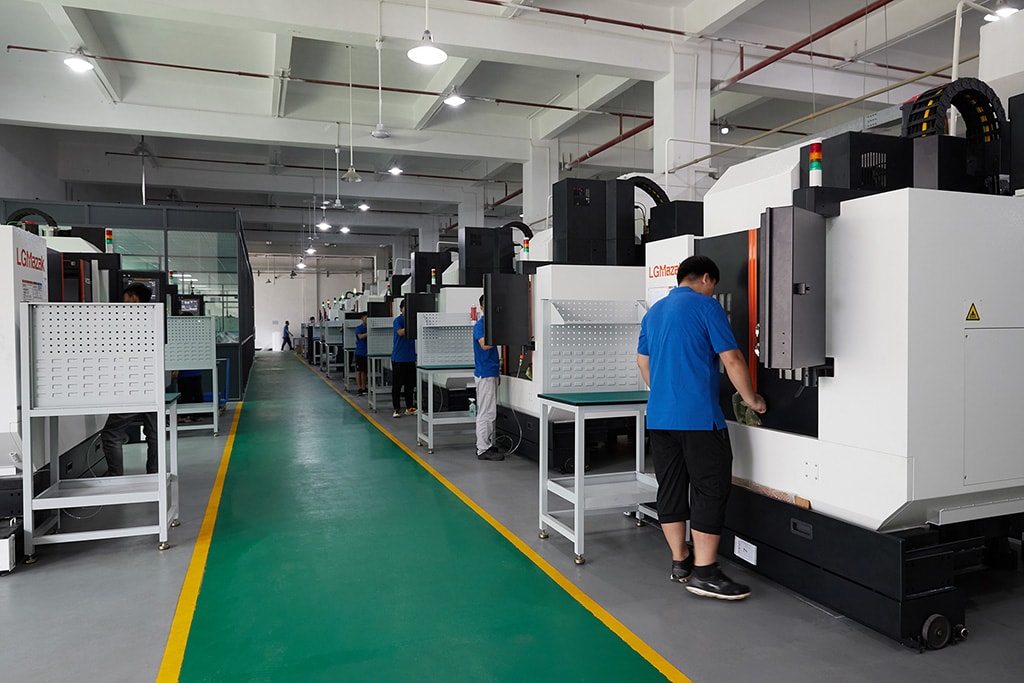
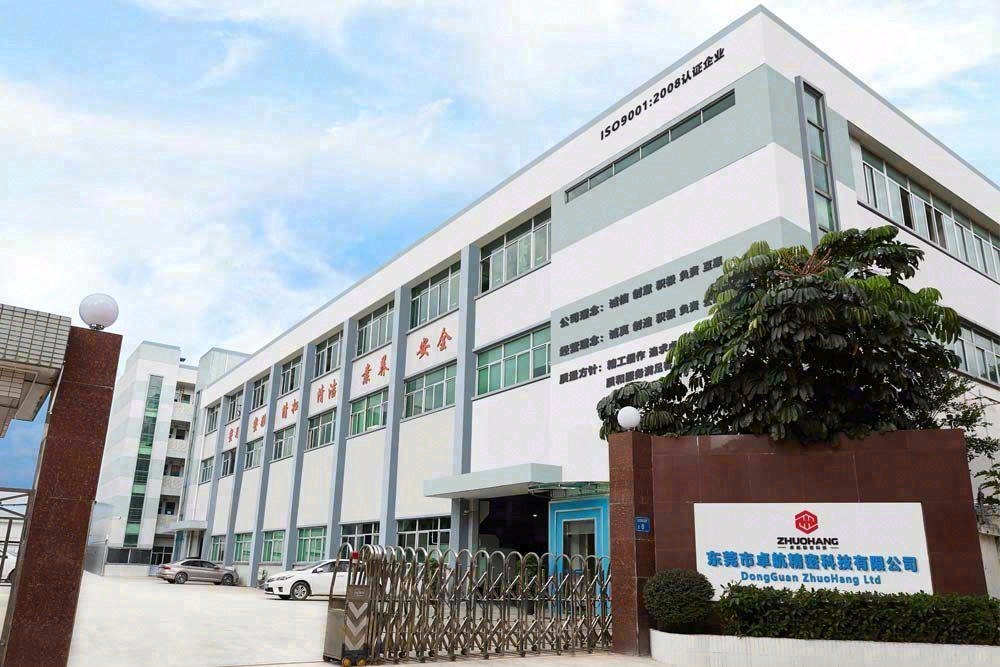
Capability evidence should come as specifics, not slogans. Behind this guide is a 6,800 m2 plant in Dongguan, China running 100+ CNC machines with 100+ staff. The machine list by category:
- 5-axis machining centres (10+) - Mazak VARIAXIS I-600 (510/910/510 mm travel, 12,000 rpm, 22 kW, 71.6 N·m, 30-tool BT40) and Mazak INTEGREX I-250H S (B-axis 0.0001°, 24 kW, 124 N·m, 38-tool HSK-A63). Built for compound-angle parts, single-setup multi-face prismatic work, and aerospace fittings where datum transfer loss is unacceptable.
- 3-axis / 4-axis machining centres (50+) - Brother SPEEDIO S500Z2N / S700Z2N (10,000 rpm, 14/21-tool ATC, 0.7 s tool-to-tool, Z-axis 2.2 G) and Mazak VCE-430A L / VCE-570C L (10,000 rpm, 118 N·m, 24-tool ATC). Built for prismatic parts, plates, brackets, housings.
- Swiss-type turning centres (10+) - Citizen Cincom A20-3F7 (Φ20 mm, 10,000 rpm), TSUGAMI B0206-III / B0205-III (Φ20 mm, 0.1 µm), STAR SR-32JII / SR-32J Type N (Φ32 mm, 8,000 rpm). Built for long, slender rotational parts at ±0.002 mm.
- CNC turning centres (20+) - HEADMAN T70M/1250 (720 mm swing, 117 mm bore, 3,000 rpm, BMT75 12-station turret). Built for shafts, bushings, flanges up to ±0.002 mm.
- Wire EDM (5+) - Sodick AQ535L (550/350/300 mm travel, ±20° taper, 800 kg workpiece). Built for hardened tool steel, internal splines, sharp internal corners that milling cannot reach.
- Inspection: Hexagon CMM + 20+ gauges - Hexagon CMM for coordinate measurement, plus vision system, profilometer, hardness tester, coating thickness gauge, XRF for material verification. The 10:1 rule (gauge 10x more accurate than the band) is applied to every feature.
- Machine highlights - VARIAXIS I-600: one-setup multi-face 5-axis + MAZA-CHECK auto-calibration; INTEGREX I-250H S: DONE-IN-ONE mill-turn, B-axis 0.0001° + Ai thermal shield; SPEEDIO S500Z2N / S700Z2N: Z-axis 2.2 G + 0.7 s ATC; Swiss-type: guide-bush switchable + 0.1 µm resolution.
Tolerance: ±0.003 mm CNC milling / ±0.002 mm CNC turning / ±0.002 mm grinding and wire EDM. Capability: Ppk >= 1.67 initial on key characteristics, Cpk >= 1.33 ongoing.
Certificates: ISO 9001:2015 (116024/A/0001/UK/En), IATF 16949:2016 (131941/A/0001/SM/En, with design clause 8.3 excluded, stated openly) and ISO 14001:2015 (116024/B/0001/UK/En), issued to Dongguan Zhuohang Ltd, registration 91441900MA4UWT6X39, founded 2005.
Where we ship: Austria, Belgium, the Czech Republic, Denmark, France, Germany, Greece, Hungary, Ireland, Italy, the Netherlands, Spain, Sweden and the United Kingdom in Europe; Brazil, Canada, Mexico and the United States in the Americas; China, Israel, Japan, Singapore and Sri Lanka in Asia; Australia and New Zealand in Oceania; and South Africa in Africa — plus other countries and regions worldwide, shipped from our base in Dongguan, China.
Contact: Felipe Iglesias, [email protected], +86 13126536955.
Ready to match the process to your material?
Send your drawing to [email protected] or call +86 13126536955 for a service and finish recommendation plus a quote.
Frequently Asked Questions
What CNC machining services do you provide?
We provide CNC milling, turning, mill-turn, and precision grinding in-house, plus bundled surface finishing and heat treatment. Milling and turning hold ±0.003 mm (milling) / ±0.002 mm (turning), and grinding holds ±0.002 mm on critical surfaces.
Can you do both milling and turning on one part?
Yes. Mill-turn centers machine complex geometry in a single setup by combining turning and milling, which removes the tolerance loss and extra handling that come from moving a part between a lathe and a mill.
What is the difference between 3-axis, 4-axis, and 5-axis milling?
In short, 3-axis cuts from three directions and suits most prismatic parts. 4-axis adds rotation for side features.
Do you provide grinding services?
Yes. Surface, centerless, and cylindrical grinding hold ±0.002 mm on bearing seats and roundness-critical surfaces. Grinding is the step that follows turning or milling when a dimension must be held tighter than cutting alone allows.
Can you bundle surface finishing with machining?
Yes. Anodizing, plating, powder coating, painting, brushing, and mirror polishing, plus heat treatment, can be bundled with machining so you receive finished parts rather than raw blanks and manage a single accountable supplier.
What files should I send to get a machining quote?
Send a STEP or IGES model plus a toleranced 2D drawing that names the material grade, finish, quantity, and target date. A complete package returns an accurate quote; a description without a model can only be estimated.
How do I know whether my part needs 4-axis or 5-axis milling?
In short, It depends on the features. If the part has side features that would otherwise need re-fixturing, 4-axis is usually enough.
Can you machine from a single prototype to a production batch?
In short, Yes. Our MOQ is 1 piece, so you can start with a single prototype to confirm the process and the fit, then move to a production batch on the same machines and settings.
Standards referenced on this page
- ASTM B211/B211M-19 — Standard Specification for Aluminum-Alloy Rolled or Cold Finished Bar, Rod, and Wire
- ASTM A484/A484M-24 — Standard Specification for General Requirements for Stainless Steel Bars, Billets, and Forgings
- ISO 9001 — Quality management systems — Requirements